Skip navigation

Category Archives: General Discussion

Everything that goes on here.

I want you to think of a few things that will help you to remain mission minded. For the record, these are things I ask myself, or pose to myself on a regular basis; today has been one of those days.


God is sovereign, he placed you where you are.

You will be going into work, or staying home, or taking rest today because it was ordained by God. This same God knit you together in your mother’s womb, he also knit the people around you in their mother’s womb. The people you will see today are intended for you to see, they are not an accident.

Do you believe that?


You have nothing to fear or worry over, your food, your clothing, your social status.

Do you know what it is to be hungry? Do you know what it is to be a social pariah? Do you know what it is to be underdressed. Now ask yourself this, what did my worrying do to improve/resolve this problem? I believe when you evaluate that you realize it contributed nothing. I believe you will realize it is in God’s hands.

Do you believe that?


We go day in and day out, neglecting our God.

Our very hearts and minds drift from him towards desires of the flesh. Towards what will satisfy us physically and emotionally, we whore ourselves to it. Our work, our children, our church, our friends, ourselves.

Do you believe that?


We do not deserve one iota of respect, patience, peace, mercy, or love from the almighty being that created us.

We deserve to die, we are like dust before the lord. Apart from God and then compared to God, we don’t even register. We couldn’t even stand in his presence! We couldn’t even look at him!

Do you believe that?


This same God sent his only son, himself, in the flesh, to DIE for YOU.

Do you believe that?


We are forgiven, we are forgiven, we are forgiven, WE ARE FORGIVEN!

Do you believe that?


Who can stand before our God!? Who can hold back his hand!? How can anyone not be amazed by our God? If you see him, hear him, feel him, know him, then how can you not be amazed by our God?

Do you believe that?


From the overflow of our hearts comes praise and worship.

What is praise? If your child learns to walk, if you get a new car, if you got a great deal on clothes; how do you react? You want to tell everyone about it, if you are like me you can’t shut up about it! That is praise, how much MORE then should we praise God? What has been done for us? We are forgiven, we are loved, we are provided for, we will live forever, we are heirs to the throne, we are children of the light. Why would we not talk about it? If our God is in control, and we are forgiven even though all signs say we shouldn’t be; then why are we not on FIRE to tell people?


There is no feasible excuse outside of: we don’t believe.

Recently I was subjected to a “spill” regarding a lack of “can do attitude”.

Now lets be clear on this.

This speech came to my team after disclosing that certain job functions owned by others should be completed by others.  Mind you, our assistance is certainly available if needed, but if it falls out of our realm of requirement or ability it shouldn’t be our responsibility for it’s completion.

There have been other times where saying “no” was tied directly towards not following a path that would lead to serious operational and financial issues at a later time.  These instances were met with the same response.

This type of mentality leads to a lot of frustration, in my environment, and in others.  Not to mention stress for those around who have to audible and absorb the shock of reckless decision making.  Especially decision making that is driven by a single party, who against advisement; persists on a course of destruction.  On the way vilifying those who oppose them from a sense of stewardship and reason.

This has become a serious problem in our business culture.  I do believe, for the sake of innovation, we need to challenge things.  I do believe we need to ask “why not”, but when the answer for why not is sound you need to stop.  The best I can figure is that this mentality is simply driven by the ego, or ignorance of the individual making the decisions.  Either they trust themselves far more than their advisors, or they don’t fully grasp what they are being advised about.  In some instances it may be both, and all they can see is the future praise they expect to receive upon crossing their finish line.  What’s worse?  This behavior is greatly encouraged in management.  The individuals who are supposed to manage and decide on the greater interest of the company are taught to do so off their gut and some pop-psych concept of anything is possible.

What is wrong with saying no?  What is wrong with saying the cost of this implementation and it’s continued support far outweighs any of it’s benefits?  What is wrong with saying I can’t do something?  What is wrong with saying, “we have people paid to perform these jobs, why is it on our plate and not theirs?”

Nothing, there is nothing wrong with it.  The argument might come up that we aren’t team players, but the last time I checked a team was the sum of all members and not one member doing the work of all the other members.  Each has a role to serve and they serve it, that is a team.  Carrying the burden of a few or supporting team members where you can, sure, but not out right taking over their position.

To someone in management reading this I would tell you these two things that will infinitely improve your situation and your subordinates:

  1. Don’t commit from a position of ignorance
    • Ignorance of the subject, or it’s criteria
  2. Trust your subordinates
    • Trust their advisement
    • Trust their knowledge

    One last thing on trust. If you can’t trust them, why are they still working for you?

    Alright, so last time I closed out my(sql) post I promised some more advanced queries etc.  Well let’s first start by playing around with some basic query syntax.

    Think back to what I wrote about it being a logical grouping of data like a spreadsheet.  So surely we can pull specific data right?  Of course, this is where sql shines, and it couldn’t be simpler.

    select user_id0 from temp.test_users; 


    Pretty simple right?  Ok, well let’s grab user id’s and their location, that should also be simple enough.

    select user_id0, location from temp.test_users;


    Now how about just the user’s located in Birmingham, al?

    select user_id0, location from temp.test_users 
    	where location like 'birmingham%';


    Ok, let’s take a moment now and examine what we’ve just covered here in such rapid succession. These are simple select statements, and the primary data retrieval method in SQL.

    select <column, names> from <server.database.table> 
    	[where <conditions of the search>]


    You can use * for column names to select them all, and using where is not required for your statements, but advised for a precise query.  Couldn’t be easier could it?  A cool little tidbit too is using as in your query to modify your column names, using our previous select for user id’s and location lets do it again and rename our columns User ID and Place:

    select user_id0 as 'User ID', location as 'Place' 
    	from temp.test_users 
    where location like 'birmingham%';


    What?  That’s it?  Pretty nifty huh?  Ok, let’s turn the difficulty up a little bit now and join tables for a cross reference.  Ok, I built a bogus phonebook table with similar data to our test_users table.  In that table I have some phone numbers, but not the full name of the users.  I want to pull the users full name and phone number, here’s how I could do that:

    select test.last_name, test.first_name, phone.number 
    	from test_users as test 
    left outer join phonebook as phone 
    	on 
    phone.userid = test.user_id0;


    Ok, you can put the paper sack away, and breathe easy.  That’s not nearly as complex as it looks or sounds.  Let’s break it down piece by piece and examine it real fast.  First we will look at the output:

    +-----------+------------+--------------+
    | last_name | first_name | number       |
    +-----------+------------+--------------+
    | belcher   | daniel     | 205-111-1111 |
    | rich      | derrek     | 813-111-1113 |
    | george    | amanda     | 205-111-1112 |
    +-----------+------------+--------------+


    In our select statement we see column last_name, first_name, and number.  We examined earlier about using ‘as’ to define a name, and that’s what we have done during that select statement.  We’ve named the table test_users as test and phonebook table as phone.

    So, before defining the column name we are selecting, we have to identify FROM which table.  In this case; test.last_name, test.first_name, phone.number

    Now, let’s examine the data I put into phonebook to better understand how this join is working.

    +--------+---------+----------------+--------------+
    | userid | last    | location       | number       |
    +--------+---------+----------------+--------------+
    | dbel   | belcher | birmingham, al | 205-111-1111 |
    | ageo   | george  | birmingham, al | 205-111-1112 |
    | drich  | rich    | tampa, fl      | 813-111-1113 |
    +--------+---------+----------------+--------------+


    Ok, as you can see, the userid column is identical to our user_id0 from test_users which makes it a prime anchor point for our join. So we perform a left outer join on test.user_id0 and phone.userid.

    Now wasn’t that easy?

    Finally we are going to look at a subquery.

    select user_id0, last_name, first_name 
    	from test_users 
    where location in ('birmingham, al') 
    order by user_id0;


    This should prove very simple to read.  If the data stored under location matches birmingham, al then it is pulled.  You could easily add more criteria to the subquery by adding it along with a comma to separate the value.  So; where location in (‘birmingham, al’,’tampa, fl’)

    There are other ways to achieve similar outcomes using OR and AND, but this is a much cleaner and shorter method for doing it.

    That’s it for now, perhaps I’ll have another sql post with even more interesting sql techniques in the future.

    To all things God gets the glory.  This is something of a doctrinal mantra, but is it something you believe?

    We know that God is faithful according to Scripture.  Having on a multitude of occasions fulfilled his promises to his elect.  Not necessarily in their lifetimes, but certainly fulfilled.

    So what do these two things tell us about God’s character, and what it should mean to his elect?

    Its never too late, and nothing is impossible. 

    God is most glorified when we are most incapable of receiving glory.  That is what is meant when it is said “my power is made perfect in your weakness” when we are removed, and God is the only one to receive the due credit, he will be most glorified.

    So take heart, that when you are broken, and all appears lost  There is God, and in him there is our hope. 

    So then what does his faithfulness have to do with that? 

    Well he has promised that all good to those who love him and are called according to His purpose for His glory.  If you are His, and in you is His glory, and that glory is in your good; how can you lose?

    I don’t say that from a prosperity stand point, but from a point of faith and promise.  In the vastness that is God’s grace and mercy, we find even more to love him for.

    In our brokenness we find his Glory, and like everything he does, it’s a beautiful reversal.

    Alright, so lately at work I’ve been up to my eyeballs in SQL.  More specifically MSSQL, but SQL none the less.  So, I wanted to take some time to discuss it and some basic stuff that, even home users, might find useful.  Considering this is a wordpress blog and it uses mysql to store it’s post and configuration data, I’ll use mySQL examples for my code snippets.  Now let’s get started by creating our database.

    create database temp;


    Now let’s create a table for users.

    create table temp.test_users
    (User_ID0 char(50),
    last_name char(50),
    first_name char(50),
    location char(50));


    Let’s stop and break this down for a second.  We just created our first database and named it temp.  Now inside of that database we’ve just created a table with 4 columns with a limit of 50 chars per entry.

    So what is that exactly? 

    Well, a database is just a logical grouping of data.  One easy way to think of a database is to think of a spreadsheet.  We’ll use excel as our example.

    The database is your workbook, and a table is a worksheet.

    So we’ve got a table now, lets insert some data to play with in there.

    insert into temp.test_users
    (User_id0,last_name,first_name,location)
    VALUES
    ('dbel','Belcher','Daniel','Birmingham, AL');
    insert into temp.test_users
    (User_id0,last_name,first_name,location)
    VALUES
    ('drich','Rich','Derrek','Tampa, FL');
    insert into temp.test_users
    (User_id0,last_name,first_name,location)
    VALUES
    ('ageo','George','Amanda','Birmingham, AL');


    Lets see how that data looks?

    select * from temp.test_users;


    +----------+-----------+------------+----------------+

    | User_ID0 | last_name | first_name | location       |

    +----------+-----------+------------+----------------+

    | dbel     | belcher   | daniel     | birmingham, al |

    | drich    | rich      | derrek     | tampa, fl      |

    | ageo     | george    | amanda     | birmingham, al |

    +----------+-----------+------------+----------------+


    Hmm, it would be great if we had a date stamp along with this data for a creation data footer.

    alter table temp.test_users
    add date0 char(50);


    Now, how are we going to update these entries?  I mean we could

    delete from temp.test_users;


    And recreate all those previous insertions with a new date column.  But that just isn’t efficient, especially if we had an even larger table than this.  It would be nice if we could look through our selects and just append that data.  But wait, we can…

    update temp.test_users
    SET date0 = CURDATE()
    where date0 is null;


    Pretty neat huh?  Well, maybe, let’s see how our data looks now.

    select * from temp.test_users;


    +----------+-----------+------------+----------------+------------+

    | User_ID0 | last_name | first_name | location       | date0      |

    +----------+-----------+------------+----------------+------------+

    | dbel     | belcher   | daniel     | birmingham, al | 2011-08-31 |

    | drich    | rich      | derrek     | tampa, fl      | 2011-08-31 |

    | ageo     | george    | amanda     | birmingham, al | 2011-08-31 |

    +----------+-----------+------------+----------------+------------+

    Alright, now there goes the basics of building, updating, and viewing a (my)SQL database and table.  Really simple huh?  I’ll try and post some slightly more advanced stuff in the next week.  Like joining tables, and creating subqueries.

    I guess until then you can RTFM (read the flippin manual).

    I’ve officially migrated this wordpress blog to it’s own domain.

    https://lotekness.net

    That is all.

    thumbs-up-haruhi

    As is the case with everything it starts with God.

    I’m speaking to believers here of course, but take the time to really reflect on God and who he is.  Infinite, immutable, omnipotent, righteous, perfect in every way.

    Really get in there, think about this.  Sovereign, in control of everything.  Knowing the end from the beginning, working all things to his glory and to the good of those who love him.  The only thing in existence worthy of praise, because through him all things are made.

    Now, stop and look at yourself.

    Whoring ourselves out to anything that can offer you a quick fix to your immediate pleasure.  Even in our most righteous state, we are still unimaginably self centered and dirty.

    Really get in there, into the darkest recesses of your mind where no one but you can hear the most intimate desires of your heart.  Really focus on that for a second, is that desire for God?  Is that desire wholesome?  Is that desire a desire you honestly believe God looks favorably upon?  Sin, is in the heart, not the act.  By sheer desire for a thing, apart from God, we have committed idolatry.  Like disobedient children, we choose our own way, completely defiant and ignorant to the right punishment we deserve.

    The wages of sin is death.  There is no other way to look at that.  Now hold that thought for a moment.

    Perfect God, compared to fallen man.

    Focus on this now for a moment.

    We deserve nothing, nothing but wrath.

    Really stop and be honest with yourself, innocence vs. guilt.  The guilty should die no?

    Yes, by all rights we should die.  Yet, instead of wrath, instead of death, instead of destruction, we receive mercy?

    Not only mercy, but we receive God himself, as a living sacrifice to atone for our sins.  To not only die for us, but to live the life we couldn’t possibly live.  One of perfection, of righteousness, then obediently take death on a cross, and separation from the perfect communion with the God head.

    We not only received this INCREDIBLE salvation, but we also received a place alongside God as co-heirs to the throne.

    We are not worthy.

    We will never be worthy.

    We owe our everything to God, for his mercy, for his steadfast love, for his promise, for his good nature, for himself.

    So how do you love your neighbor?  The same way it began with God, and ends with God.  You love them the way God loves you.

    Unendingly, sacrificially, mercifully.


    On a more regular basis I’d like to keep a stream of technical write ups, gaming news, theological thoughts, and or general “what’s going ons” with me and my family.  However with a work trip to Houston last week and general slap busy nature of my work since returning home; I’ve not had any time to collect some thoughts and formulate them into a blog post.  I want to hit some high points, and perhaps elaborate on them more in future posts.

    High point #1 Samba DC

    Ok, so people who have known me for any extended amount of time (from the age of 16 to 30) knows that I’m a Linux fan.  My work and lively hood mind you thrive around a Microsoft world, but I will never sell Linux short, nor fail to marvel at the amazing things that a thriving community of passionate individuals can create.  I also maintain a Linux server out of my home to manage DNS, DHCP, VOIP (TeamSpeak) and File sharing (NFS, iSCSI, and SMB).  I will also, on occasion, bring up outward facing game servers.  Just recently I decided to convert that server into a SAMBA DC for my, primarily, Windows 7 environment at home.

    I run CentOS as my server distribution, which is a downstream of RHEL.  I’m running Samba version 3.5.4, at the time of this writing 3.6 is the latest stable release but didn’t offer enough improvements for me to go outside of my natively distributed yum version.

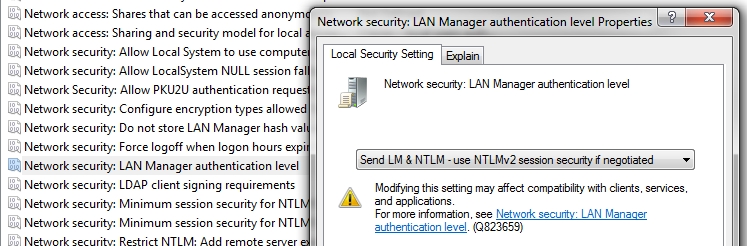
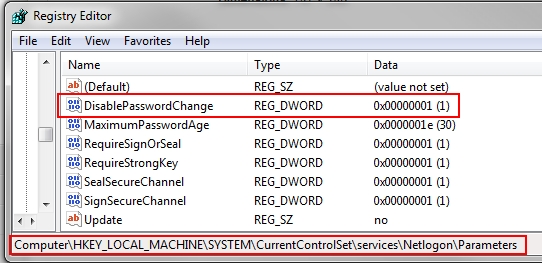
    Also, aside from a few changes to the registry and local security policy that had to be made on the client side of the machines, the migration was fairly painless.

    The first change resolves the issue of Windows 7 being able to find the domain for insertion, and the security policy solves the issue of Domain Trust at login.  It’s also wise to disable the password reset of the machine to DC to avoid potential relationship issues.  I’d not seen this issue myself, but until I see a confirmation it’s resolved (supposedly coming in samba 4) I’ll err to the side of caution.

    My next step will be to integrate Open LDAP functionality into the DC, and an Apache http server.  I assume these will be fairly painless projects, but for risk of breaking my current domain environment I’ll need to wait till I have the time to deal with a potential ldap migration failure.  I also don’t have a strong enough list of pros for it since this is just a home network.  Mind you it’s more sophisticated than the average home network, it just seems a bit over engineered.  As for the Apache server, I really want to get back into some web development so I’d like the internal server for development purposes….


    service httpd start

    Ok, so now I’m running an Apache server off my server as well.  Linux is so hard.


    High point #2 Admin Studio 10

    So I was in Houston last week.  I’m now “officially” trained to use Admin Studio 10 for package (msi, app-v, xenapp, and thinapp) development, repackaging, and migration.

    So what does that mean?

    Well as most of you know I work with a product from Microsoft called SCCM.  One of the primary features of SCCM is application deployment.

    So what is application deployment?

    Simply put, it’s installing applications to multiple machines over a network.

    Ok, I think I see.  So why would you need to do package development to deploy packages?

    Well, you don’t have to.  One could feasibly shoehorn an installer given by a vendor, but ideally you want to build out a standardized installer or load for your company.  For us that means I’ll be building MSIs, MSTs, and App-v packages.  As well as isolating application installs that might otherwise break functionality of OTHER applications they share hard drive space with.

    Wait, what?  Isolate, break, huh?

    Almost all applications rely on libraries.  Think of them as a set of shared instructions that applications go to when asked what to do.  Well in most cases these libraries are shared by multiple applications.  And, sometimes one application wants a vanilla library, and another wants a chocolate.  Well these apps will fight, and one of them will win and another one will lose.  By isolating them I can give them what they want so they don’t break the system, or each other.

    Our company will also leverage App-v packages which are essentially virtualized installs of these applications that, although they run locally on the machine, they are actually virtualized (or encapsulated) and are separate from the actual operating system.  Xenapp and Thinapp do the same thing.  I’m particularly excited about application virtualization, it can come with a bit of overhead, but it’s nice and contained.

    Ok, I stopped caring somewhere around chocolate and vanilla.

    Yea I figured as much.  Either way, it is a tangible notch to my hard skill set and I’m glad that I was able to get it done.


     High point #3 Gospel in Life

    What does a Gospel centered life look like?

    What does it mean to be in the world but not of the world?

    Is the Gospel as narrow minded to culture as people often proclaim it to be?

    What does a Gospel centered community look like?

    These are part of the current bible study I’m involved in with my brothers and sisters in Christ called Gospel in Life by Timothy Keller. It’s a great study that forces you to take a look at your heart, your life, and your community and compare it to what and how it is defined in the Gospel. I would recommend this study to anyone who is a believer. Even if the information isn’t new to you, as most of it hasn’t been for me, it’s still food for the soul. A reminder of the higher purpose we are called to as Christians.

    Truthfully, I’d encourage non-believers as well to read this study. If for nothing else, than to hold Christians accountable to the teachings that we claim to believe.


    High Point #4 Ignoring my Family

    I’ve taken way to long to blog this, and my wife has informed me that I should blog about how I’ve ignored my family, to blog.

    When she’s right she’s right.  Thank God for her gentle reminders.


    /begin spill

    I’m not really sure where to start on this, but I feel compelled to talk about how incredible my wife is. 

    She consistently supports me when I feel like I’m in over my head.  She allows me to lead, and remains respectful in her dissent.  She maintains and controls what would other wise be anarchy in the home.  She’s an amazing mother, nurturing, and disciplining in equal and proper proportion.  Selfless in her service to her family.  She seeks to find what it is that brings myself and her children the most joy, and works towards those ends.  Her love is a beautiful and humbling thing to behold. 

    My wife has a bead on me, and is truly my best friend.  She challenges me to push beyond what I would normally settle for, and is continually used to temper and humble me.  She’s the one person I want to go to bed with, and the one person I want to wake up next to.  I can’t imagine being apart from her, or trying to face this world without her.

    Do we fight?  Yes.  Do we always agree?  No.  Do we both love God and trust him to lead us?  Yes.  Do we face trials? Yes.  Does that matter?  Yes. 

    God knows what he is doing, and he knew what he was doing when he brought us together.  It pains me greatly that knowing joy through my wife, and my children, I would so quickly have (and did at times) settled for less growing up.  It also makes me realize, this joy pails in comparison to that which I will feel when in the presence of our father.

    /end spill

    As a Systems Engineer/SCCM Administrator I spend a lot of time parsing through data, and assisting support technicians in tracking down failing assets.  Now mind you, I have plenty of reports that give me the information I need to identify the machine and users and techs responsible etc, but what happens when I get a random list of employee names from a project manager that has 0 access to user ids or asset numbers for machines?  Well, I have to find that information, then spend time later pointing them to resources I’ve made available for them; but that’s another topic….

    Anyway, I face both problems, I’ll receive a list of userids or usernames and have to resolve them one against another.  Well thanks to powershell I’m able to do so quickly and easily through profile functions.  Now, I’ll explain the benefits of profile functions after the code below:


    Import-Module activedirectory
    
    #-------------------------------------------------------------------- 
    Function Get-UserName { 
    [CmdletBinding()]
    
    PARAM($USERID) 
    Get-ADUser $USERID | select name 
    } 
    Set-Alias gun Get-UserName 
    #-------------------------------------------------------------------- 
    Function Get-Userid { 
    [CmdletBinding()] 
    PARAM([string]$NAME) 
    $NAME = $NAME + "*" 
        Get-ADUser -Filter {Name -like $NAME} | select samaccountname,name 
    } 
    Set-Alias guid Get-Userid 
    #--------------------------------------------------------------------

     How do I use profile functions?!?

    Powershell, much like the BASH shell in Unix/Linux, has a profile “script” so to speak at startup.  There is a global one found at:

    • %WinDir%System32WindowsPowerShellv1.0Profile.ps1
    • %WinDir%System32WindowsPowerShellv1.0Microsoft.PowerShell_Profile.ps1
    • %WinDir%System32WindowsPowerShellv1.0Microsoft.PowerShellISE_Profile.ps1

    The same filename syntax is used for the user profile versions:

    • %UserProfile%My DocumentsWindowsPowerShellProfile.ps1
    • %UserProfile%My DocumentsWindowsPowerShellMicrosoft.PowerShell_Profile.ps1
    • %UserProfile%My DocumentsWindowsPowerShellMicrosoft.PowerShellISE_Profile.ps1

    See a pattern?  Simple enough right?  None of these profiles exist by default though, they must be created.  The names are fairly indicative of what they control, but here’s a breakdown:

    • Profile.ps1
      • This governs startup of both the standard powershell, and the ISE.
    • Microsoft.PowerShell_Profile.ps1
      • This governs startup of the standard powershell console only.
    • Microsoft.PowerShellISE_Profile.ps1
      • This governs startup of the ISE powershell console only.

    Simple enough right?  Now, for the sake of simplicity, lets build a current user version of the profile.ps1 and save the above code to it.  Make sure you’ve installed the activedirectory cmdlet module provided with windows 7. Now launch powershell and viola you should now have the cmdlets:

    • Get-UserName
    • Get-UserID

    and their aliases:

    • GUN
    • GUID

    Ok, now what?

    Here’s the thing about profile functions.  You can treat them like cmd-lets now.  That also means that you can script against them.  Consider them a static variable for every powershell session that you have configured with this profile.

    Pretty cool huh?  One of the most powerful features of the shell is it’s configurability, and profile functions and aliases are the tip of that spear.

    In the case of user name capture, or id capture, I’m but a simple gc and for-each statement away from processing the list given to me.

    I hope this helps broaden your practical understanding of profiles, and gets your creative juices flowing for building your own administrative tool kits.  Happy scripting.